
Freiburg-im-Breisgau: Where Nature and Urban Life Converge
A Medieval Foundation
The story was begun in 1120 when Duke Konrad of Zähringen established a settlement at this strategic location. A marketplace was created where trade routes converged, and the settlement was granted its freedoms and rights. The Münster, a Gothic cathedral whose construction was started in 1200 and completed over three centuries, still dominates the skyline. Its filigree spire, reaching 116 meters into the sky, has been called one of the most beautiful church towers in Christendom.
Inside the cathedral, light filters through medieval stained glass windows that somehow survived the bombing raids of 1944. The colors shift throughout the day, painting the stone floor in brilliant hues of red, blue, and gold. Around the Münsterplatz, market stalls have been set up every morning since the Middle Ages. Today, local farmers still arrive before dawn to arrange their vegetables, flowers, and regional specialties in the same spots their ancestors once claimed.
Things to do in Freiburg-im-Breisgau
The Bächle: Arteries of the Old Town
One of the city's most distinctive features runs throughout the historic center – the Bächle, a network of small water channels originally constructed in the 13th century. These narrow streams, fed by the Dreisam River, were designed as a medieval water management system, providing water for firefighting and livestock while also serving as a drainage network.
Legend has it that anyone who accidentally steps into a Bächle will marry someone from the city. Whether or not this proves true, the gurgling waterways have become beloved by residents and visitors alike. On hot summer days, children can be seen splashing in the cool water, while others simply dangle their feet over the edges, finding relief from the heat. The Bächle serve as a reminder that practical solutions, when thoughtfully designed, can become cherished elements of urban identity.
An Academic Tradition
The University was founded in 1457 by Archduke Albrecht VI of Austria, making it one of Germany's oldest institutions of higher learning. Through wars, occupations, and political upheavals, knowledge has been pursued within its halls. Notable figures have walked these grounds – from philosopher Martin Heidegger to economists like Walter Eucken, whose theories on social market economy helped shape post-war Germany.
The student population of roughly 30,000 has shaped the city's character significantly. Cafés and bookshops line the streets around the university buildings, their windows displaying philosophical treatises alongside contemporary fiction. In the evening, discussions spill out from lecture halls into beer gardens, where debates about literature, politics, and life continue late into the night. The presence of so many young people has kept the city vibrant and progressive, always questioning, always evolving.
A Green Pioneer
Perhaps no aspect of the city has drawn more international attention than its commitment to environmental sustainability. This wasn't a recent trend but a decision made decades ago. Following the oil crisis of the 1970s, when many communities reconsidered their energy consumption, serious steps were taken here. Solar panels were installed on public buildings. Bicycle infrastructure was expanded dramatically. Car-free neighborhoods were planned and built.
The Vauban district, constructed on the site of former French military barracks, has become a model for sustainable urban development worldwide. Streets have been designed to prioritize pedestrians and cyclists. Solar panels cover nearly every roof. Cars, while not banned, have been made deliberately inconvenient – parking spaces must be purchased separately at considerable expense, and they're located in multi-story garages at the neighborhood's edge. As a result, roughly 70 percent of Vauban families live without private vehicles.
The Rieselfeld neighborhood offers another example. Wetlands were created as part of the development, serving both as recreation spaces and natural water management systems. Tram lines were built before the first residents moved in, ensuring public transportation was never an afterthought. These weren't just experiments in green living – they were bold statements about what cities could become.
Between Mountains and Vines
Geography has blessed this location generously. To the east, the Black Forest rises in waves of dark green pine, its trails beckoning hikers and mountain bikers. The Schauinsland, at 1,284 meters, can be reached by cable car or by winding road, and from its summit, views stretch across the Rhine Valley to the Vosges Mountains of France. In winter, its slopes fill with skiers; in summer, paragliders launch from its peaks, circling like colorful birds above the valley below.
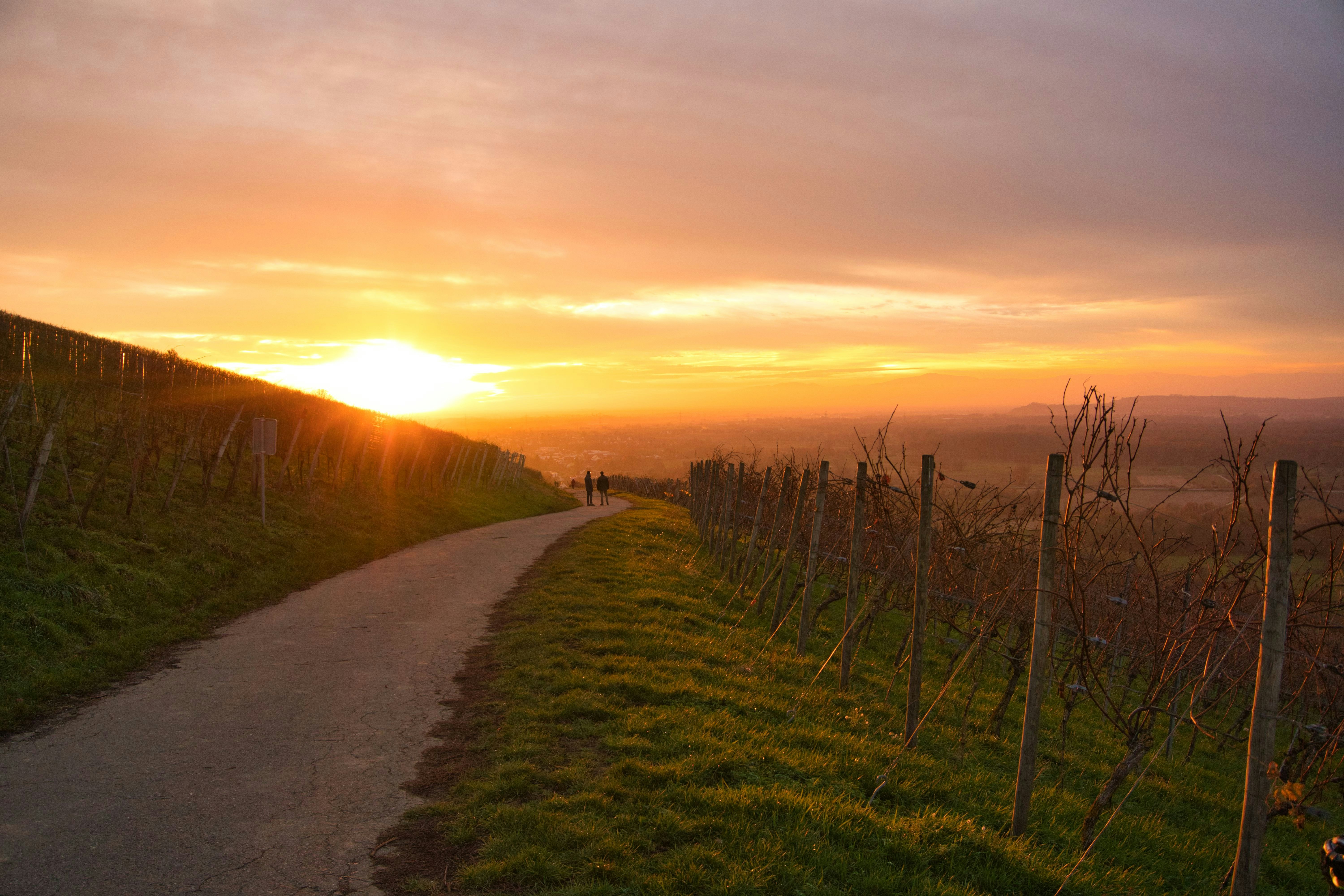
To the west, the Rhine Plain spreads toward France, its gentle hills covered in vineyards. The Baden wine region produces exceptional vintages, particularly the Spätburgunder (Pinot Noir) that thrives in the warm climate. Wine taverns dot the surrounding villages, where vintners pour their latest releases and serve hearty regional dishes. The Kaiserstuhl, a volcanic outcropping that rises from the plain, creates a microclimate so warm that even orchids grow wild on its slopes.
The city itself enjoys Germany's sunniest and warmest weather, with average temperatures several degrees higher than comparable cities to the north. This climate has shaped both the local culture and the environment – outdoor cafés remain busy well into October, and the growing season extends longer than almost anywhere else in the country.
A Culinary Heritage
The food scene reflects its position at a cultural crossroads. Baden cuisine shares much with its neighbors in Alsace – the love of good wine, the appreciation for hearty yet refined dishes, the emphasis on local and seasonal ingredients. In traditional restaurants, dishes like Schäufele (roasted pork shoulder) and Maultaschen (large, meat-filled pasta pockets) have been served for generations.
The Münstermarkt offers a feast for the senses each morning. Stalls overflow with produce from nearby farms – asparagus in spring, strawberries in early summer, mushrooms in autumn. The Lange Rote, a distinctive local sausage, sizzles on grills, its aroma mingling with the scent of fresh-baked pretzels. Cheese vendors offer samples of mountain cheeses from the Black Forest, while others sell jars of forest honey and homemade preserves.
Yet the culinary landscape hasn't remained frozen in time. International influences have been welcomed, creating a dining scene that ranges from traditional Gasthäuser to innovative fusion restaurants. Turkish, Vietnamese, and Italian eateries have become neighborhood fixtures, while the weekly farmers' market in Vauban showcases organic and biodynamic producers from the region.
Music and Festival
Cultural life has been enriched by a strong tradition of music and celebration. The Zelt-Musik-Festival, held each summer since 1983, transforms the city into a stage for world music, jazz, and alternative rock. Concerts are performed in a massive tent erected in the Mundenhof park, creating an intimate atmosphere despite audiences of thousands.
Street performance thrives here as well. On warm evenings, musicians, jugglers, and artists claim spots around the Münsterplatz and along the Kaiser-Joseph-Straße. The Fasnet, the local carnival celebration, explodes each February in a riot of costumes, parades, and satirical performances. The tradition dates back centuries, offering a release valve where social norms can be questioned and authority figures mocked – all in the spirit of good fun.
Living History, Building Tomorrow
Walking through the streets at dusk, when the last sunlight catches the cathedral spire and the Bächle reflect the warm glow of streetlamps, the layered history becomes palpable. Buildings destroyed in the war were reconstructed with painstaking care. Traditional timber-framing techniques were employed alongside modern materials. The past wasn't simply preserved – it was honored and integrated into a living, breathing urban fabric.
Yet this respect for history hasn't translated into resistance to change. The city has positioned itself as a testing ground for new technologies and urban planning concepts. Solar research institutes collaborate with the university. Startup companies develop clean energy solutions. Urban gardens sprout on former industrial sites, tended by residents who want to reconnect with food production.
The balance struck here – between preservation and innovation, between nature and urbanity, between tradition and progress – offers lessons for cities worldwide. Solutions haven't always been perfect, and debates continue about the pace and direction of development. But the willingness to experiment, to take risks, to imagine alternative futures, has created a city that feels both timeless and urgently relevant.
As evening settles over the old town and bicycles stream homeward through streets built for horses and carts, something becomes clear: the success of this place wasn't achieved by choosing between past and future, but by weaving them together. Every medieval building renovated with modern efficiency standards, every solar panel installed on a historic roof, every ancient market tradition adapted to contemporary values represents a refusal to accept false choices.
For those seeking to understand how communities might navigate the challenges ahead – climate change, urbanization, maintaining human connection in an increasingly digital world – this Black Forest city offers not prescriptive answers but provocative questions. What if we designed cities for people rather than cars? What if we prioritized long-term sustainability over short-term convenience? What if we believed our choices today could actually shape a better tomorrow? For travelers drawn to places where wine flows as freely as ideas and where mountain trails begin where medieval streets end, a visit to nearby Stuttgart reveals yet another dimension of southwestern Germany's complex character.


 Home
Home Wishlist