
Matera: A City Carved from Stone and Time
The Sassi: Where Rock Becomes Home
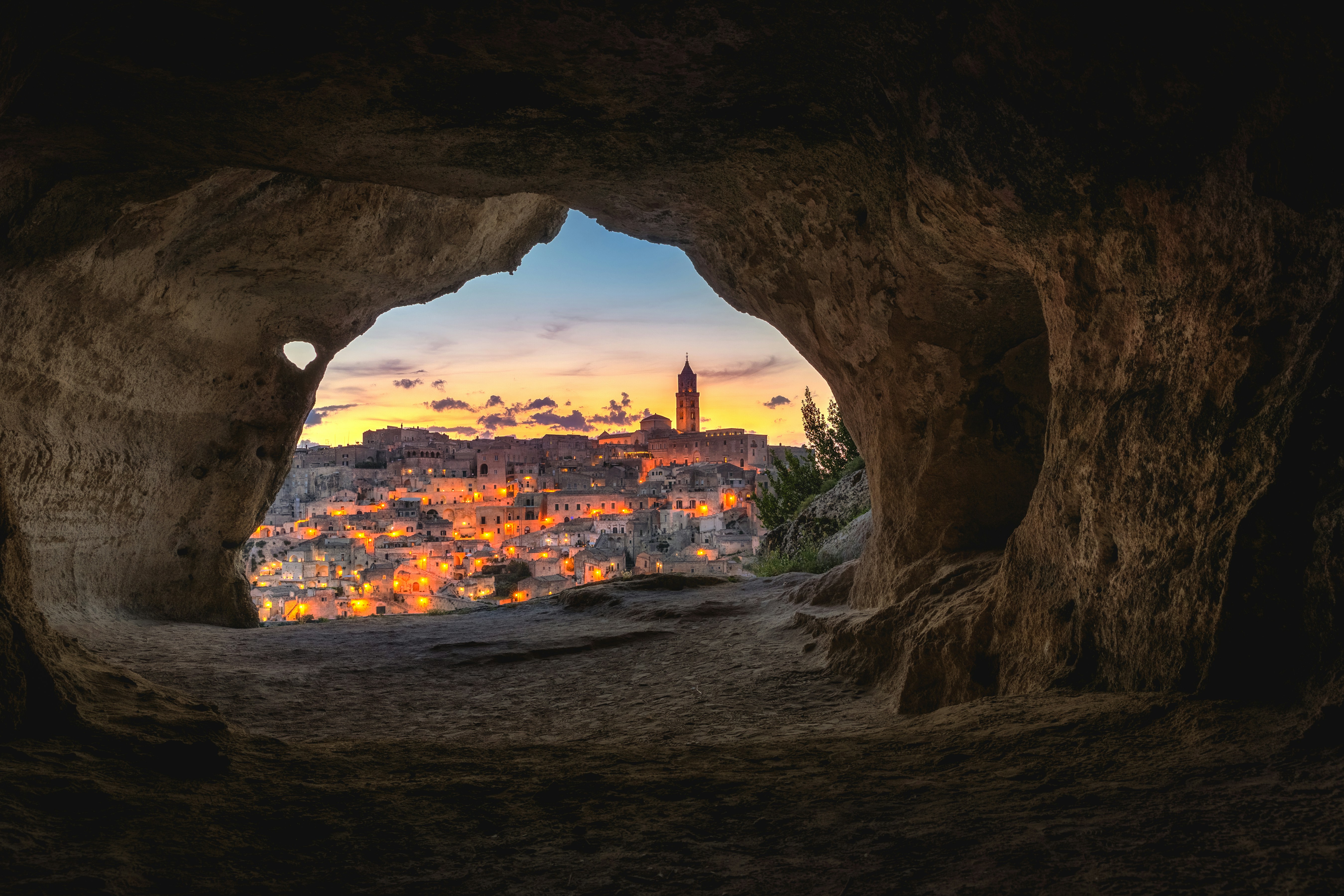
The word "sassi" translates simply to "stones," but this understates what has been created here. Two districts—Sasso Barisano and Sasso Caveoso—cascade down opposite sides of a rocky gorge like frozen waterfalls of honey-colored stone. These weren't built so much as excavated, hollowed from the soft tufa rock that defines the landscape.
From a distance, the dwellings appear stacked atop one another in impossible configurations. What seems like a rooftop terrace often serves as the entrance to another home carved deeper into the cliff. Streets that wind through the districts function as multilevel pathways, connecting cave houses that have sheltered families for generations. The architecture defies conventional logic—rooms extend backward into darkness, natural temperature regulation was provided by the earth itself, and rainwater collection systems were ingeniously integrated into the rock.
Walking through these districts feels like navigating a three-dimensional maze where time has been compressed into stone. Every corner turned reveals another layer of history, another ingenious adaptation to life within living rock.
Things to do in Matera
A History Written in Layers
Evidence of human habitation here dates back to the Paleolithic era, making this one of the longest continuously occupied settlements anywhere on Earth. The caves offered natural shelter, and early inhabitants expanded them, creating the foundation for what would become an entire city.
During the Middle Ages, monks fleeing religious persecution arrived and carved elaborate churches into the rock faces. These rupestrian churches, over 150 in total, were adorned with frescoes that still survive in many cases. Byzantine artistic traditions were painted onto rough stone walls, creating sacred spaces that merged spiritual devotion with geological reality.
By the 17th and 18th centuries, the sassi had grown into a complex urban environment. Families, livestock, and commercial activities all shared these cave spaces. The population swelled, and living conditions became increasingly cramped. What had once been ingenious adaptation gradually became desperate overcrowding.
Decline and Disgrace
By the early 20th century, the sassi had become synonymous with poverty and disease. Nearly 15,000 people lived in the cave dwellings, often in conditions of extreme deprivation. Multiple generations shared single-room caves with their animals. Fresh water was scarce, sanitation virtually nonexistent. Malaria and other diseases ran rampant through the cramped quarters.
In 1952, writer Carlo Levi published "Christ Stopped at Eboli," describing the conditions as a national shame. The book sparked controversy and action. The Italian government, embarrassed by international attention, forcibly relocated the entire population of the sassi between 1952 and 1968. New housing developments were constructed on the plateau above, and the ancient cave dwellings were abandoned and left to decay.
For two decades, the sassi stood empty—a ghost town carved in stone, windows like hollow eyes staring across the ravine at their mirror image.
Renaissance from Ruins
What was once considered shameful gradually came to be seen as precious. Scholars and preservationists recognized the historical and architectural significance of what had been abandoned. The cave dwellings represented thousands of years of human adaptation, an irreplaceable record of how communities could thrive in challenging environments.
In 1993, UNESCO designated the sassi a World Heritage Site, acknowledging them as "the most outstanding, intact example of a troglodyte settlement in the Mediterranean region, perfectly adapted to its terrain and ecosystem." This recognition sparked a remarkable transformation.
Restoration projects began in earnest. Cave houses were carefully renovated, preserving their historical character while incorporating modern amenities. What had been impossible living conditions became uniquely atmospheric dwellings and businesses. The key was finding balance—honoring the past while making the spaces viable for contemporary use.
A New Chapter Unfolds
Today, the transformation can scarcely be believed by those who remember the forced evacuations. The sassi have become some of Italy's most sought-after locations. Cave houses have been converted into boutique hotels where guests sleep in rooms hollowed from ancient rock. Restaurants occupy spaces where families once huddled with their livestock. Art galleries display contemporary works against backdrops of stone that witnessed Byzantine monks at prayer.
The population has returned—not the descendants of those forcibly relocated, but new residents drawn by the unique character of cave living. Young entrepreneurs have opened wine bars in former cisterns. Artisan workshops produce traditional crafts in caves that once housed entire families. The streets that fell silent for decades now buzz with visitors from around the world.
This rebirth reached global consciousness when the city served as the setting for numerous films, including Mel Gibson's "The Passion of the Christ" and the recent James Bond film "No Time to Die." The distinctive landscape and architecture provided filmmakers with settings that could pass for ancient Jerusalem or exotic spy film locations.
Living Among the Stones
But the city remains far more than a film set or tourist curiosity. Real life continues in these ancient spaces. Morning markets fill small piazzas with the scent of fresh produce and local cheeses. Children play in squares where their ancestors played centuries before. Elderly residents sit outside cave dwellings, watching the endless stream of visitors with patient amusement.
The rupestrian churches have been carefully restored, their faded frescoes revealing Byzantine artistry. Santa Maria de Idris, carved into the peak of the Monterrone rock, offers breathtaking views across the ravine while sheltering paintings that have survived hundreds of years. San Pietro Barisano, the largest rock church, reveals the complex relationship between natural caves and human modification—rooms carved deeper and deeper into the mountain, each generation expanding the sacred space.
Casa Grotta, a preserved cave dwelling, shows visitors how families lived here before the evacuation. The single room housed parents, children, and animals. A small hearth provided heat and cooking space. Water was collected drop by precious drop. The stark conditions are sobering, making the subsequent transformation all the more remarkable.
The Gravina Gorge
The sassi face each other across the Gravina gorge, a dramatic limestone canyon carved by the stream that shares its name. This natural barrier has shaped everything about the settlement's development. Ancient pathways wind down the gorge walls, connecting the city to the plateau opposite. Caves dot both sides of the ravine, some still unexplored, others revealing traces of habitation stretching back millennia.
Walking through the gorge feels like stepping outside time entirely. The stream below moves as it has for thousands of years. Hawks wheel overhead, their cries echoing off stone walls. The city perches above, its honey-colored facades glowing in the Mediterranean sun, while down here in the shadowed depths, the connection to ancient human presence feels immediate and visceral.
Cuisine Born from Scarcity
The culinary traditions here were shaped by centuries of poverty and resourcefulness. Pane di Matera, a durum wheat bread with a distinctive flavor and long shelf life, earned its own Protected Geographical Indication status. The hard crust and dense interior made it practical for families who needed their bread to last.
Crapiata, a soup made from legumes, wheat, and whatever vegetables were available, embodied the peasant tradition of making something nourishing from humble ingredients. Peperoni cruschi—crispy fried peppers—added flavor without requiring expensive ingredients. These dishes, born from necessity, have become celebrated elements of Basilicata's cuisine.
Modern restaurants have elevated these traditional preparations while honoring their origins. In cave dining rooms where families once struggled, sophisticated interpretations of peasant dishes are now served to international visitors. The irony isn't lost on anyone, but neither is the respect shown to the traditions being preserved and celebrated.
Walking back through the illuminated sassi as evening settles over the ravine, the transformation feels complete yet the ancient presence remains undeniable. These stones have witnessed human struggle and triumph across millennia. They've sheltered monks and families, endured shame and neglect, and ultimately earned recognition as treasures worth preserving. For those seeking similar historical depth elsewhere in Italy, Verona offers its own layered past, where Roman foundations support medieval monuments in an equally compelling narrative of continuity and change.


 Home
Home Wishlist