
Venice: A City Built on Dreams and Water
The Impossible City
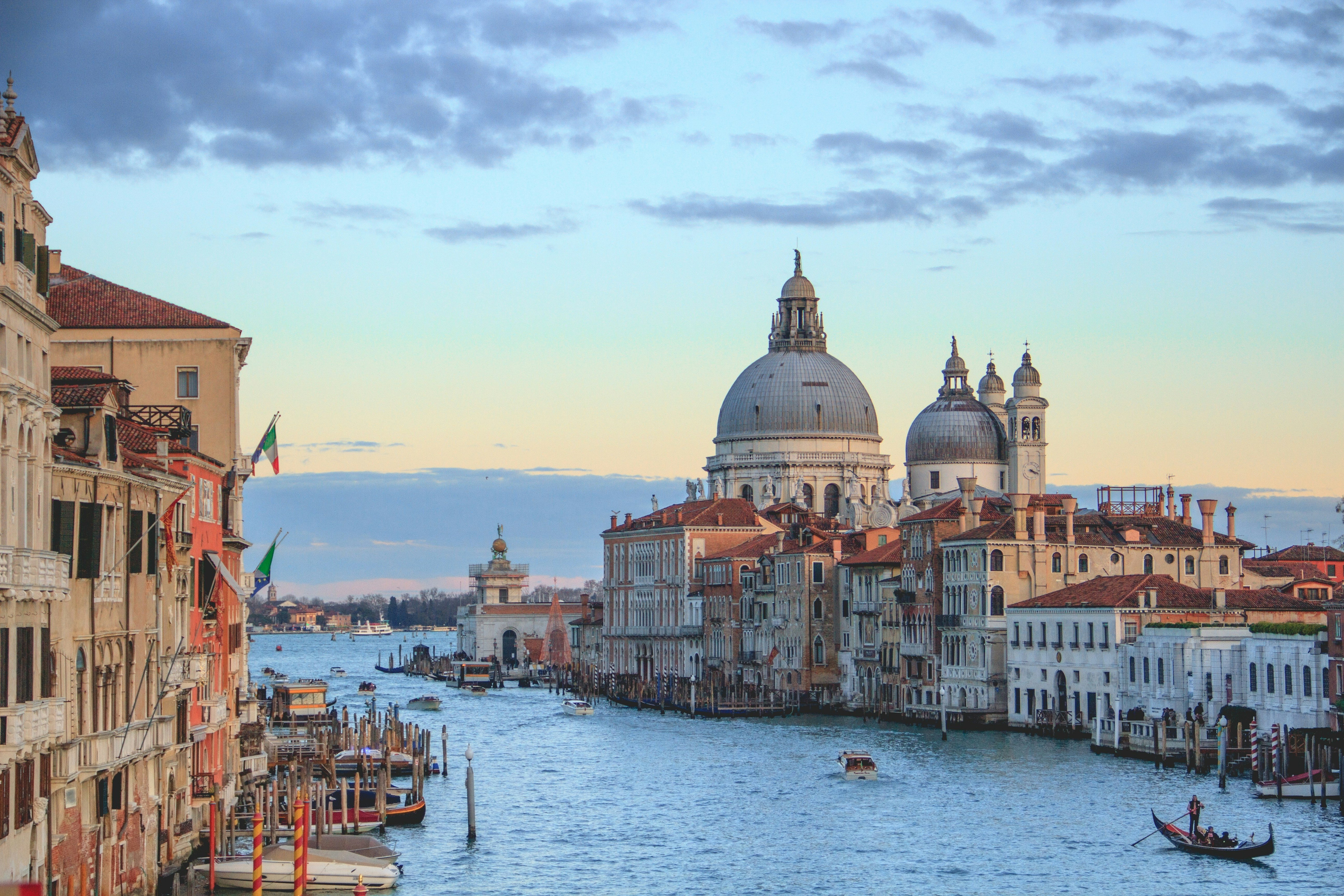
The audacity of its very existence remains staggering even today. By the 5th century, refugees fleeing barbarian invasions had established settlements on 118 small islands scattered across a shallow lagoon. What began as a desperate escape would be transformed over centuries into one of history's most powerful maritime republics. The techniques developed by those early settlers – driving thousands of wooden stakes into the marshy ground to create stable foundations – can still be observed in the city's construction today.
Engineering challenges that would have deterred others were met with remarkable innovation. Grand palazzos were erected on what should have been unbuildable terrain. Elaborate systems of canals were carved out to serve as streets, creating a unique urban fabric where water became not an obstacle but the very lifeblood of daily existence. The Grand Canal, that sinuous waterway cutting through the heart of the city, functions as both main thoroughfare and living museum, its banks lined with structures spanning nearly every architectural period.
Things to do in Venice
A Republic of Merchants and Artists
For over a millennium, political and economic power radiated from this unlikely capital. The Venetian Republic controlled trade routes throughout the Mediterranean, its merchant fleets bringing spices, silks, and treasures from Constantinople, Alexandria, and beyond. Wealth accumulated through commerce was poured into art and architecture, commissioning works from masters whose names still resonate through history.
The Basilica di San Marco stands as perhaps the ultimate expression of this prosperity and ambition. Byzantine domes rise above a facade encrusted with marble columns, mosaics, and treasures plundered from across the known world. Inside, golden mosaics cover nearly every surface, creating an otherworldly atmosphere where divine and earthly power seem to merge. The building itself serves as a three-dimensional record of centuries of acquisition and artistic achievement.
Adjacent to the basilica, the Doge's Palace presents an equally impressive display of Gothic architecture and political symbolism. For centuries, the elected leaders of the republic conducted affairs of state within these pink and white walls. Elaborate chambers were decorated by Tintoretto, Veronese, and other Renaissance masters, their massive canvases celebrating military victories and allegorical virtues. Yet even in these grand halls, reminders of the republic's darker side remain – the Bridge of Sighs, through which convicted prisoners were led to their cells, still connects the palace to the old prisons.
Canvas and Light
The unique quality of Venetian light – softened by reflection off water, filtered through maritime haze – has been captured by artists for centuries. The Venetian School developed distinctive techniques for rendering color and atmosphere, approaches that would influence painting across Europe. Titian, Giorgione, and Bellini worked here, developing rich palettes and dramatic compositions that seemed to glow with inner radiance.
In the 18th century, Canaletto and Guardi documented the city's daily life and spectacular vistas through their vedute – detailed views that combined architectural precision with atmospheric effect. Their paintings were collected by Grand Tour travelers as souvenirs of their Italian journeys, spreading images of Venetian grandeur across Europe. Today, many of these masterworks can be viewed in the Gallerie dell'Accademia, where room after room displays the evolution of Venetian artistic achievement.
Hidden Corners and Secret Passages
Beyond the well-trodden tourist circuits, countless discoveries await those willing to wander. Tiny campi (squares) suddenly open up among dense building clusters, often centered around a well that once provided fresh water to the neighborhood. Small churches hide remarkable artworks behind unassuming facades. In the Jewish Ghetto – the world's first, established in 1516 – buildings were constructed unusually tall to house a population confined to a limited area, creating a distinctive architectural character.
The neighborhoods of Cannaregio and Dorsoduro offer glimpses of more everyday Venetian life. Here, local shops still serve residents rather than tourists, and traditional bacari (wine bars) pour ombre (small glasses of wine) to regulars who've been coming for decades. Markets like the Rialto still function much as they have for centuries, with vendors selling fresh fish pulled from the lagoon that morning.
Craft and Tradition
Traditional crafts continue to be practiced in workshops scattered throughout the city. Murano glass, produced on nearby islands since 1291 when furnaces were moved there as a fire precaution, remains synonymous with exquisite artistry. Master glassblowers can still be watched as they transform molten material into delicate sculptures, chandeliers, and vessels using techniques passed down through generations.
Gondola construction represents another vanishing art. Only a few squeri (boatyards) still build and maintain these iconic vessels, each one crafted from eight different types of wood and requiring over 500 hours of skilled labor. The distinctive asymmetric design – the boat curves slightly to compensate for the gondolier's weight on one side – was perfected over centuries of refinement.
The Rhythm of Water
Daily life continues to be governed by the tides in ways visitors might not immediately recognize. When acqua alta (high water) floods the lower-lying areas, elevated walkways get assembled to keep pedestrians dry. Sirens warn of incoming floods, and residents don rubber boots as a matter of routine. Yet these periodic inundations, growing more frequent and severe, remind everyone of the city's precarious relationship with the lagoon that gave it life.
The MOSE project – a system of mobile barriers designed to protect the lagoon from exceptional tides – represents the latest chapter in centuries of hydraulic engineering. Whether this technological intervention can preserve the city for future generations while maintaining the delicate lagoon ecosystem remains an open question, one that carries implications far beyond these islands.
Beyond the Guidebook
To experience the city fully requires patience and a willingness to get lost. The labyrinthine layout, where streets end at canal edges and bridges lead in unexpected directions, frustrates GPS and challenges conventional navigation. Yet this very disorientation often leads to the most memorable encounters – a hidden courtyard where climbing roses spill over crumbling walls, a small campo where children play while grandmothers watch from benches, a sudden vista of domes and campaniles framed between buildings.
Early morning and late evening offer different perspectives than the crowded midday hours. Dawn reveals the city in soft pastels, mist rising from canals as delivery boats make their rounds. After sunset, when day-trippers have departed, restaurants fill with locals, and the sound of conversations and laughter echoes off ancient walls. These quieter hours reveal rhythms that might otherwise remain hidden beneath the tourist bustle.
The magic worked upon visitors by this improbable city has been described by countless writers, painters, and travelers over centuries. Yet words and images inevitably fall short of the lived experience – the sensory totality of light on water, the musical quality of the Venetian dialect, the centuries of history condensed into every weathered facade. Much like the artistry found throughout other Italian treasures such as Florence, this floating masterpiece continues to inspire and amaze all who encounter it, reminding us that human creativity can triumph over seemingly impossible circumstances.


 Home
Home Wishlist